
Wi-Fi has an increasing array of use cases, with the days of a single use Wi-Fi network behind us.
Many customers are looking to use their network for multiple purposes and one of these is to location track tags and devices.
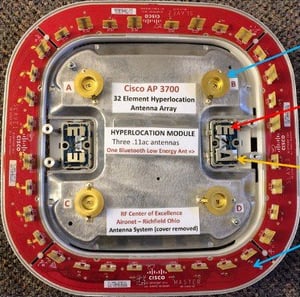
Here we review how the typical AP layout for location grade WLAN is laid out - but also take a look at the Cisco Hyperlocation module and how that might help you achieve the highest levels of location accuracy.
What is a Wi-Fi Location Tag? Tags are small Wi-Fi transmitters, which can be attached to objects to allow them to be tracked.
If you're interested in a bit of a background read on how to make Wi-Fi work, take a look at the Top 8 Secrets to Great Wi-Fi.
Wi-Fi Location Tracking
Traditional wireless location tracking is based solely on RSSI (Received Signal Strength Indication).
This is how loud the AP can hear the clients, and is used to work out the client position.
APs use the RSSI to estimate distance from themselves to a client.
Since each AP only knows the distance to the client but not the direction, one AP is not enough to identify the location of the client; a minimum of 3 APs with good signal strength is recommended in order to trilaterate the location.
With a good Location Grade design, typically quoted figures are 5 - 10m of accuracy, although this can drift in wide open areas.
Location Grade Predictive Wi-Fi Survey
Wi-Fi Predictive Designs are the starting point for any RF design and that includes Location Grade Wi-Fi.
Predictive surveys need to be followed up with Pre-Deployment surveys to really offer an effective tool for design.
The recommended AP design/layout is to place the APs in a staggered manner (rather than a grid or just down the centre of corridors) and also around the perimeter of the building.
In reality, the RF environment is affected by many factors, especially wall position and wall type and this affects the AP positioning as well.
Recommended AP Locations
 It is recommended to position APs around the perimeter of a building, so that all tracked clients are on the inside of that perimeter.
It stands to reason that if you only position a single AP in a location, you will be able to get location accuracy of 'nearest AP', but that's going to give quite a wide expanse over which the client could be located.
Location grade designs typically have the highest density of the various types of RF survey designs that we undertake.
As with all RF designs, a Wi-Fi Pre-deployment Survey should be conducted to confirm the AP placement in the predictive survey is correct.
Cisco Hyperlocation
Location-Grade Wi-Fi: FAQs
What Is Location-Grade Wi-Fi?
A Wi-Fi design where access points are placed so every location is heard by at least three APs at a usable signal level, allowing a location engine to work out where tags and devices are. It typically needs more APs than a data or voice design.
Why Do APs Need to Be on the Building Perimeter?
Location engines estimate position from the APs that hear a device. If APs only sit in the middle of a building, devices near the outside walls can be placed outside it — corner and perimeter APs keep locations inside the footprint.
How Many More APs Does Location Tracking Need?
As a rule of thumb, room-level (about 10 m) accuracy needs roughly 10% more APs than a voice-grade design, and tighter accuracy needs more again. A predictive survey confirms the count for your building.
Can Location Accuracy Be Checked Before Go-Live?
Yes. The predictive design shows third-AP (tertiary) coverage, and an onsite calibration or validation survey confirms accuracy once the APs are installed.
AP Placement: Location Grade Wi-Fi: Summary
Location services are used widely with Wi-Fi. This allows location tags to be tracked to easily find equipment, or to help in hospitals to cancel nursecall - there are many uses for location services with Wi-Fi.
Need Help With Location Services?
IPTel deploys Cisco Spaces and location-ready Wi-Fi for hospitals and enterprises. See our healthcare page, or if that would be useful, get in touch with the IPTel team or email sales@iptel.com.au.