
CT Scanners are a pretty impressive looking bit of clinical technology.
At what must be an anxious time for patients, it's nice to see how the hospitals are working hard to make a nicer environment for patients.
Hospitals rely heavily on technology and have a highly mobile workforce - who often need to get help and assistance quickly.
Some of the technology is pretty awesome to look at in its size and scale (and cost) too. Let's take a peek at what a CT Scanner looks like!
Hospital and Clinical Wi-Fi
Just before getting into the CT Scanner, some quick detail on hospital Wi-Fi. Hospital Wi-Fi tends to stand above the Wi-Fi deployed in almost any other environment.
First up, it needs to work! Hospital Wi-Fi can be used for a bunch of simultaneous services (think of patient entertainment screens, BYOD, Guest, BioMedical, Location Tracking, Hospital Wayfinding, duress and of course, Corporate Access).
There's such a wide array of services, which are now specific to Wi-Fi in hospitals. Let's not forget about the basics too - Wi-Fi Voice (which is often in need of remediation in hospitals). Clinical Hand Hygiene is a good value add service too.
If you're interested to read a bit more about how to get your clinical Wi-Fi working, we've got a free download, the Top 8 Secrets to Great Wi-Fi.
There's a huge amount of technology in your average hospital - some of it is quite daunting to look at - and none more so than the CT Scanner - especially when it starts up.
CT scanners use X-rays, so metal on a patient mainly affects the quality of the images. MRI scanners are a different story - they use a very strong magnet, so we can't even put a Wi-Fi access point in an MRI room.
CT Scanner: Inside Detail
I’ve been working in and around hospitals for a number of years now. The size, cost and complexity of some of the equipment you see is quite mind boggling in the clinical space.
I don’t know too much about CT scanners, but I came across these couple of really great pictures recently:
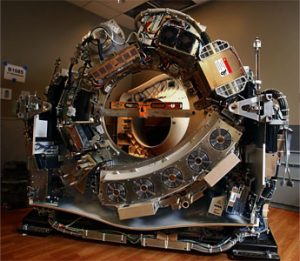
Normally shaped like a giant white doughnut, the photo above shows the scanner with the covers off – there’s a lot of equipment there under the surface.
I gather they’re pretty noisy in operation, and by the looks of it there are a lot of cooling fans that would be generating all that noise.
Patient Friendly Technology
Considering patients have to lie stock still in this quite intimidating machine, it's nice to see that some hospitals have really gone the extra mile.
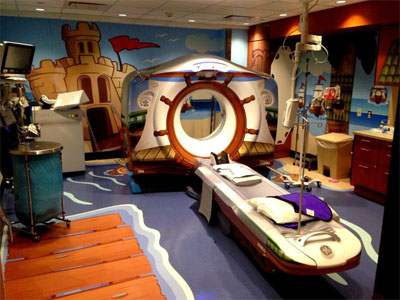
One of my colleagues came across this photo, which we think is from a hospital in Washington (not sure if that’s Washington state or DC). It's amazing what a bit of inventiveness can do and you can clearly see how it must be so much more calming for young patients to get their scans in this room than in the standard clinical room.
Clinical Wi-Fi: FAQs
Can Wi-Fi Work Inside a CT Scanner Room?
Imaging rooms are often lead-lined, so signals from corridor APs are heavily attenuated. If coverage is needed in the room, an AP inside it is usually required.
Why Do Imaging Areas Need Special Attention in a Wi-Fi Design?
Lead shielding, heavy equipment and walls that look like plasterboard but aren't can all create coverage holes. The design should model these walls correctly and be checked on site.
Is Wi-Fi Safe Around Imaging Equipment?
Wi-Fi runs at low power and medical equipment is tested for electromagnetic compatibility. Always follow the hospital's biomedical engineering guidance for specific rooms.
How Is Clinical Wi-Fi Validated?
With a pre-deployment survey before installation and a validation survey afterwards, testing with the actual clinical devices where possible.
Clinical Wi-Fi: Summary
Wi-Fi is a major technology in the clinical space. Hospitals use Wi-Fi extensively for many functions - and it just has to work!
Use of Wi-Fi Phones and Location tracking are now commonplace. Many hospitals also use Wi-Fi for patient monitors (Philips and Draeger are major brands in this space), and as you move into BioMedical support, the reliance on Wi-Fi gets ever greater.
RELATED ARTICLE: Clinical Wi-Fi Top 5 Design Tips
Hospitals are full of hugely expensive equipment, as the scanners above illustrate. They are also full of a lot of small, valuable and highly mobile equipment - which increasingly connects via Wi-Fi (allowing remote monitoring, access and tracking).
Hospital networks really take some special attention to the design and resilience, with Wi-Fi now taking centre stage.
Need Help With Clinical Wi-Fi?
IPTel designs and validates Wi-Fi for hospitals and aged care. See our healthcare page and Wi-Fi survey services, or if that would be useful, get in touch with the IPTel team or email sales@iptel.com.au.