
Hybrid work has moved users and apps out of the office, so security has to move with them. In this blog, we'll explain what Cisco Secure Access is, how its Security Service Edge (SSE) modules fit together, how users and data centres connect to it, and what Experience Insights adds.
Secure Access: What Is Cisco's SSE Platform?
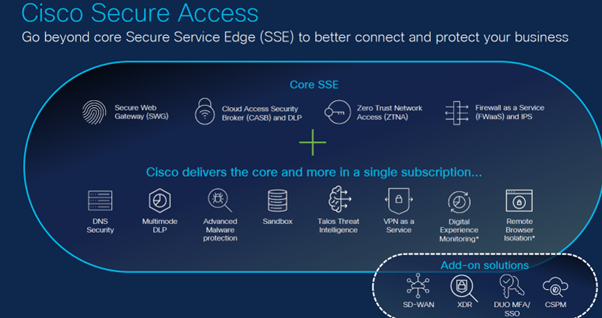
).gif?width=173&height=173&name=Cisco%20Au%20(Instagram%20Post%20(45)).gif) Cisco Secure Access is Cisco's cloud-delivered Security Service Edge (SSE) platform. Grounded in zero trust, it brings Zero Trust Network Access (ZTNA), a Secure Web Gateway (SWG), a Cloud Access Security Broker (CASB) and Firewall as a Service (FWaaS) together in one converged service.
SSE is a key enabler of any organisation's hybrid-work strategy. Your users connect from home, the office and everywhere in between, and the apps they need sit in your data centre, public cloud and SaaS. Security has to follow the user, not the building.
Secure Access goes beyond those core modules. It adds multimode data loss prevention (DLP), DNS-layer security, Remote Browser Isolation (RBI), malware analysis and Talos threat intelligence, all under one cloud-delivered platform.
If you know Cisco Umbrella, which secures traffic at the DNS and web layers, the difference is scope. With Secure Access, users can safely reach all the resources and apps they need, regardless of protocol, port or level of customisation. Newer capabilities such as AI Access, for visibility and control over generative AI apps, are part of the same platform.
Connectivity: How Do Users and Data Centres Connect?
Users connect through Cisco Secure Client, a single unified agent that carries the Secure Access modules: a VPN for Secure Internet Access (SIA) and Secure Private Access (SPA), and a ZTNA module for private access. On the data centre side, you connect with IPsec tunnels or with lightweight resource connectors.
The ZTNA module gives seamless access to any TCP- or UDP-based private application, web or non-web, in your private data centre.
Here's how the pieces fit together.
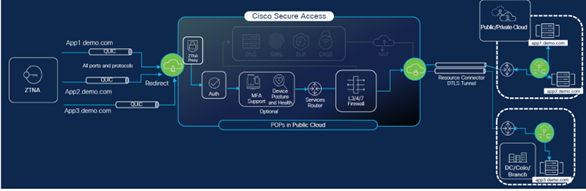
Data centres need a device that supports IPsec to build backhaul tunnels from your on-premises data centre to Cisco Secure Access.
Where an IPsec-capable device isn't an option, resource connectors fill the gap. They're lightweight virtual machines deployed in your data centre that build DTLS tunnels to the Secure Access cloud, connecting user traffic to your private resources using zero trust access. The bonus? No significant changes to your network routing.
SSE Benefits: Why Move Security to the Cloud?
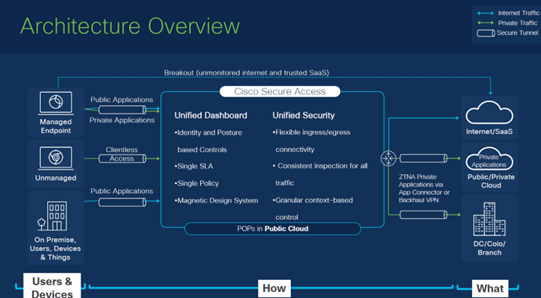
 Moving security to the cloud means the same policy follows every user, wherever they work. Cisco SSE gives you secure remote access to all private apps, defends users and resources from malware, exposes shadow IT, protects sensitive data, and monitors and inspects traffic, all from a single console.
There's an operational gain too. One client, one console and centralised policy mean fewer moving parts to deploy and run.
And because user experience insights are built in, you can lift user productivity and IT efficiency at the same time.
The graphic below summarises the key benefits.
Experience Insights: How Do You Monitor User Experience?
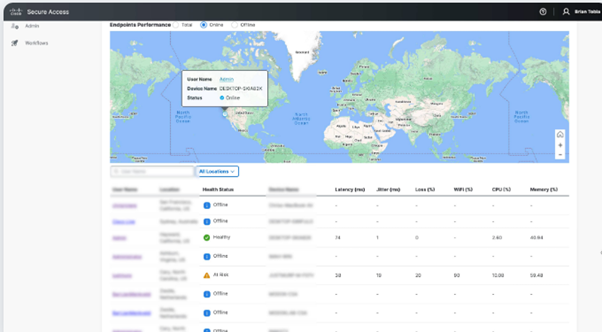
Experience Insights measures the real-time performance and availability of the applications and services your users rely on, so IT operations teams can resolve issues quickly and keep people productive. It's integrated with Cisco ThousandEyes, a SaaS product that measures network performance and delivers automated insights into digital experience.
It gives you in-depth endpoint health analysis and detailed network performance tracking. It also correlates performance with SaaS outages, so you can tell a local problem from a provider one.
On top of that, you get unified user-to-application monitoring, insights you can share across teams, and flexible monitoring options you can expand as you need them.
Here's what the Experience Insights view looks like.
If you want to take digital experience monitoring further, see our ThousandEyes Managed Services.
Cisco Secure Access: FAQs
What Is Cisco Secure Access?
Cisco Secure Access is Cisco's cloud-delivered Security Service Edge (SSE) platform. It combines ZTNA, a secure web gateway, CASB, firewall as a service, DLP, DNS-layer security and remote browser isolation, managed from one console with one client, Cisco Secure Client.
What Is the Difference Between SSE and SASE?
SSE is the security half of Secure Access Service Edge (SASE). SASE combines SSE's cloud-delivered security services with SD-WAN networking. Cisco Secure Access provides the SSE part of a SASE architecture.
Do I Still Need a VPN With Cisco Secure Access?
You no longer need your own VPN headend. Secure Access includes VPN as a service alongside ZTNA, both delivered through Cisco Secure Client. Many organisations use ZTNA for specific private applications and keep the cloud VPN for anything ZTNA doesn't suit.
How Does Cisco Secure Access Connect to My Data Centre?
Either through IPsec tunnels from a capable device in your data centre, or through resource connectors: lightweight virtual machines that build DTLS tunnels to the Secure Access cloud without significant routing changes.
Cisco Secure Access: Summary
Cisco Secure Access tackles today's challenge of safely connecting anything to anywhere. It connects any user to any app over any port or protocol, simplifies deployment and operations with a single console, unified client and centralised policy, and reduces risk with advanced security that helps keep your business running and avoid the fallout of a breach.
Need Help With Cisco Secure Access?
Our Security Service Edge managed service covers deploying and monitoring Cisco Secure Access, and our security and Cisco ISE team can help you plan a zero trust approach. Our free Security Assessment gives your business a clear health check. If that's useful, get in touch with the IPTel team or email sales@iptel.com.au.