.png?width=200&height=59&name=IPTellogo-byline-2020-dark-v2-pnd-optimised-500%20(1).png "IPTellogo-byline-2020-dark-v2-pnd-optimised-500 (1)")
In this case study we're going to look at quite a specific use case: using Splunk to monitor the quality of a Cisco CURWB or Private 5G network.
Private 5G networks are not that common but are used when a business needs the tightest control to manage the RF spectrum they're using, as well as the end device experience.
This is common for sites with a high number of users, or automated vehicles requiring a low latency, guaranteed wireless experience.
In the case of Private 5G, we have a range of items to monitor:
- End user device experience
- The radio network (RAN)
- The control network for the Private 5G
- The ICT network which provides the underlay for the Private 5G network
In this blog, we'll work through the telecommunications case study, looking at the users and the case studies, before moving onto some sample renders of dashboards.
ASSOCIATED BLOGS:
Using Splunk to Monitor Automated Vehicles
Modern ports are rapidly adopting automated guided vehicles (AGVs) and autonomous container carriers to improve throughput, safety, and efficiency. These vehicles depend on ultra‑reliable, low‑latency wireless connectivity to operate safely in complex, high‑traffic environments.
.gif?width=215&height=215&name=Splunk%20(Instagram%20Post).gif)
For many ports, Wi‑Fi alone is no longer sufficient.
There are two key technologies which are highly suited to the automated vehicle use case - these are Cisco CURWB and Private 5G.
Both are highly suitable: Cisco CURWB is cheaper to deploy, but Private 5G has protected spectrum - but is much more expensive to deploy.
Cisco Private 5G provides deterministic performance, predictable latency, and stronger mobility management — but only if the network itself is continuously monitored and operationally visible.
This is where Splunk plays a critical role.
ASSOCIATED BLOGS:
Splunk: Network Issues vs Vehicle Issues
Modern automated vehicles are used to move containers around a port. The network needs monitoring, but the vehicle can send telemetry also. With no driver in the vehicle remote monitoring is critical in spotting issues early.
.png?width=225&height=225&name=Splunk%20Healthcare%20Case%20Study%20(Instagram%20Post).png)
In automated port environments, operational teams are often alerted to a vehicle problem first:
- A container carrier slows unexpectedly- A vehicle stops mid‑route
- Safety systems trigger failsafes
However, the root cause is frequently network‑related, not mechanical:
- Latency spikes impacting control commands- Packet loss disrupting telemetry streams
- Weak radio conditions causing session instability
Without unified visibility across vehicle telemetry and Private 5G performance, teams are left guessing — switching between operational systems, network dashboards, and vendor tools while production slows.
In this rendered dashboard below, we've drawn up an image showing the sort of monitoring that might be suitable for a port and the automated vehicles: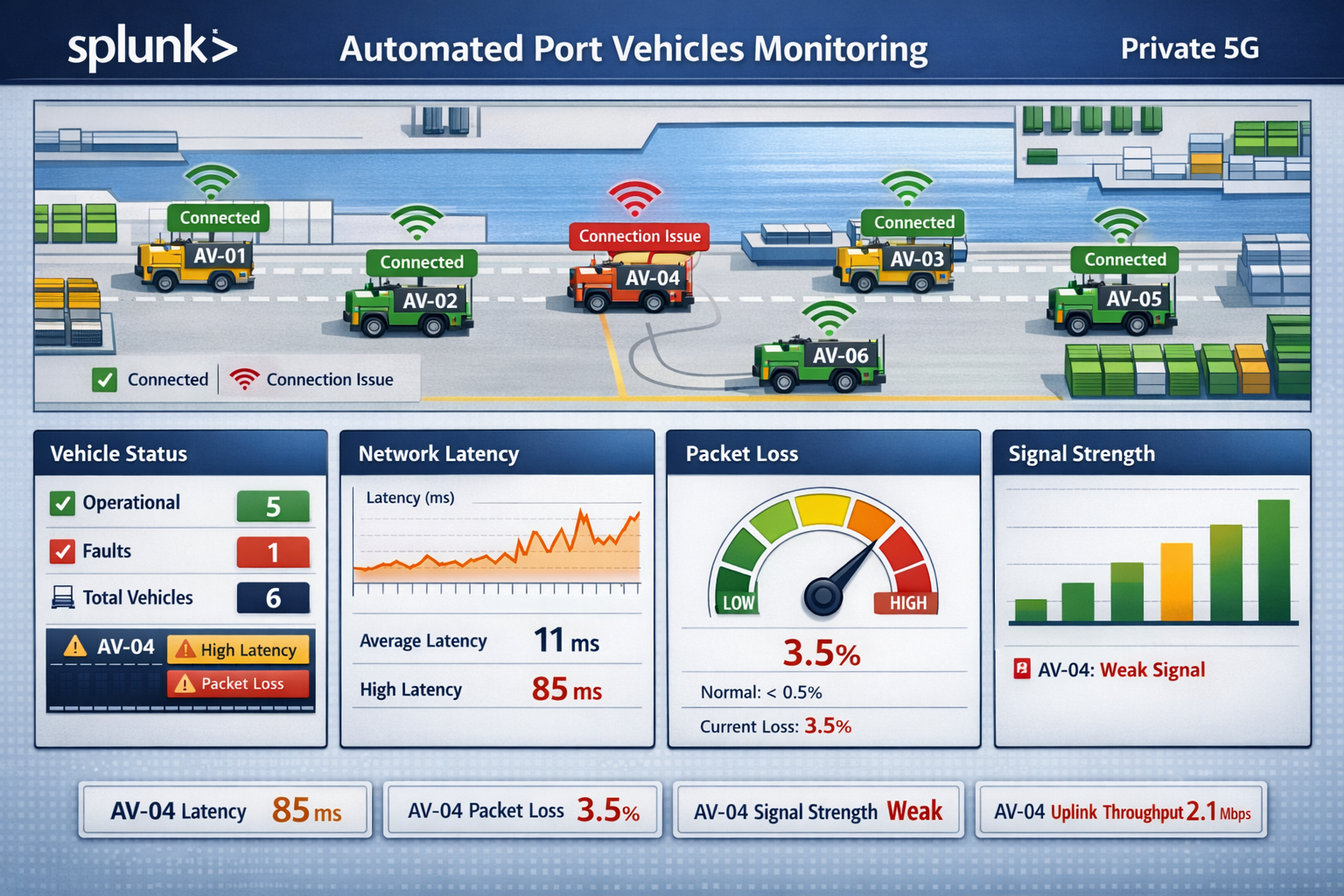
Sample Render of Splunk Glass Table View
The Splunk dashboard provides a single, operational “glass table” view of automated port vehicles and the Cisco Private 5G network supporting them.
At a glance, port operators can see:
- Each vehicle’s live connectivity status
- Which vehicles are operating normally
- Which vehicles are experiencing degraded network conditions
- Whether an operational issue correlates directly to 5G performance
Vehicles are shown spatially across the port environment, making it immediately obvious when connectivity issues are localised to a specific area, radio zone, or edge node.
ASSOCIATED BLOGS:
Splunk and Private 5G Metrics
Rather than generic uptime indicators, the dashboard focuses on 5G KPIs that directly affect autonomous vehicle behaviour.
The reason Splunk works well in the Private 5G use case, is that it is often a mix of manufacturers in use. For example in the case of Cisco Private 5G, it uses Cisco servers and software, but a Radio Access Network (RAN) from a third party (eg Nokia and others).
Splunk can collate the sources of data and correlate across them, such as SNMP, syslog, telemetry (and this will be across multiple manufacturers).
The key metrics that we need to track for Private 5G are:
-
- Network Latency
- Packet Loss
- Signal Strength and Radio Health
Let's take a look at why each of these are important - then a sample dashboard that might be used.
Network Latency
Low network latency is critical for:
.gif?width=211&height=211&name=Copy%20of%20Cisco%20AuHow%20Splunk%20Helps%20Businesses%20Discover%20Connected%20Devices%20(Instagram%20Post).gif)
- Real‑time steering and movement commands
- Collision avoidance systems
- Remote supervision and exception handling
The dashboard continuously tracks:
- Average latency across the Private 5G network- Latency spikes tied to individual vehicles
- Threshold breaches that coincide with vehicle slowdowns
Packet loss
Packet loss can be more damaging than latency, especially for:
- Continuous telemetry streams
- Video or sensor data used by control systems
- Command acknowledgements
The Splunk view highlights:
- Real‑time packet loss percentage
- Deviation from normal operating thresholds
- Which vehicles are affected first
Signal strength and radio health
Private 5G environments still rely on radio conditions being healthy:
- Signal strength
- Uplink throughput
- Vehicle location
This allows teams to quickly identify whether issues stem from:
- Coverage gaps
- Temporary interference
- Mobility handover challenges as vehicles move through the port
The sample render below is just an example how we might pull these metrics into a dashboard and monitor the various aspects of the network:
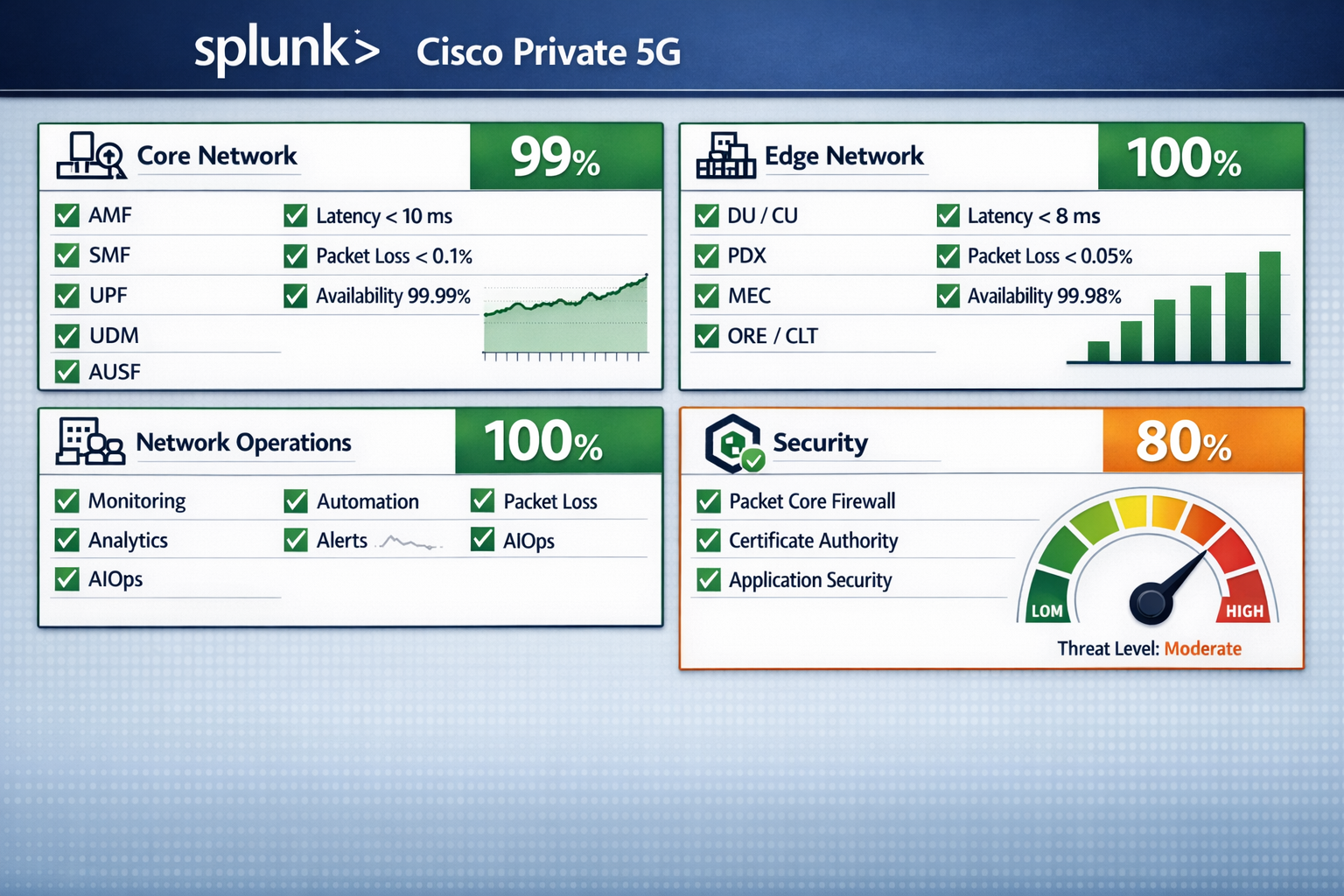
Sample Render of Splunk Glass Table View
ASSOCIATED BLOGS:
Splunk Manufacturing Case Study: Summary
In a busy port with lots of moving vehicles and devices any time there's an issue, there's a key question: Is this a vehicle issue, or a 5G network issue?
The key point of the Splunk dashboards is to answer this question as quickly as possible. The real ideal is to allow the shift from reactive troubleshooting to predictive operations.
With Splunk, we can offer:
- Real‑time visibility across vehicles and network performance
- Actionable intelligence aligned to operational outcomes
- A single source of truth for OT, network, and operations teams
If you’d like to chat over all things Splunk, or have any Splunk projects we could help you with, drop us a line at sales@iptel.com.au
ASSOCIATED BLOGS: