.png?width=200&height=59&name=IPTellogo-byline-2020-dark-v2-pnd-optimised-500%20(1).png "IPTellogo-byline-2020-dark-v2-pnd-optimised-500 (1)")
If you run a network for a living, you already know this feeling: somewhere in your estate there's a switch, a firewall or an access point that's quietly gone end-of-life. Nobody's quite sure which one it is — and right now, it's probably the easiest way into your network.
Cisco's answer to that problem is Cisco IQ.
In this post we'll unpack what Cisco IQ actually is, the problem it's built to solve, how the agentic AI underneath it works, and what it means for how you plan, run and defend your infrastructure (and how it can make recommendations to improve the security posture of your network!).
What Problem Is Cisco IQ Solving?
Every network accumulates debt. Gear ages out, documentation goes stale, and the people who remember why a particular VLAN exists move on to another job. Cisco IQ now shows in one place where you have End of Life equipment, or equipment vulnerable without service contracts:
-
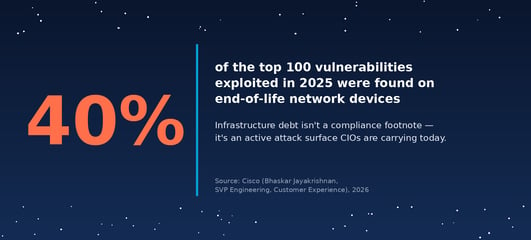
40% of the top 100 vulnerabilities exploited in 2025 were found on end-of-life devices — hardware still in production, but no longer getting security patches.
-
Cisco IQ will show you which equipment needs replacing and where you need to renew your service contracts
-
Knowing which devices need to be upgraded to deal with security exploits as well as security hardening advice are both part of Cisco IQ
The really good news is: there's no separate licence fee for Cisco IQ itself — it rides on the support contract you're likely already paying for, which makes the internal business case considerably easier to write.
Cisco IQ: CIO Overview
Cisco IQ will help you understand the networking equipment you have deployed and the status of that equipment. This will help in replacement plans, as well as where you spend your time upgrading vulnerable equipment.
Key factors for Cisco IQ:
-
It's agentic, not just generative. Cisco IQ doesn't just summarise your network — it runs AI agents that reason and act continuously, at software speed, across planning, operations and defence.
-
Three deployment options. SaaS, air-gapped on-premises, and tethered on-prem — so organisations with strict data sovereignty or regulatory requirements aren't locked out.
-
Already live: Capabilities like Peer Benchmarking and Quantum Ready Assessments are more recently available, in addition to the inventory and vulnerability reporting.
-
It plugs into what you already run. Cisco IQ sits inside Cloud Control and correlates data you're already generating — purchase history, network telemetry, your CMDB — rather than asking you to stand up a parallel system.
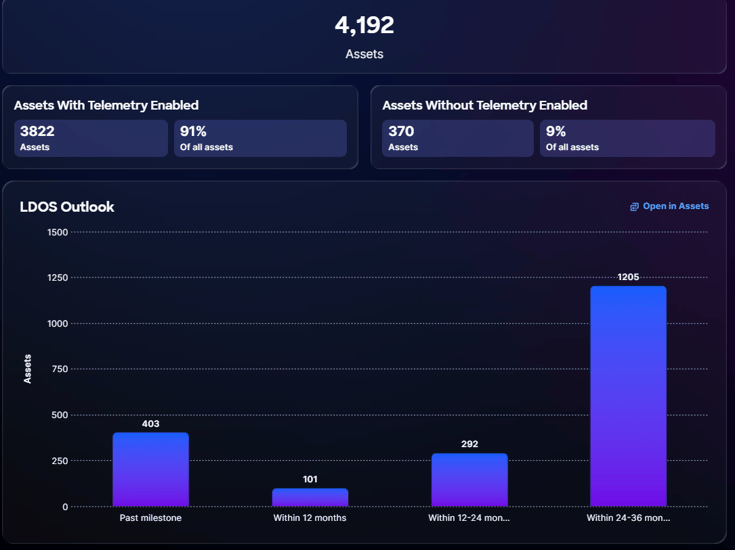
One of the clearest outputs of all that correlated data is Last Day of Support (LDOS) exposure — a live, ongoing view of exactly how much of your estate is running hardware or software Cisco's already stopped patching. This will help build your business case for your ICT spend:
Key Cisco IQ Features
Strip away the architecture talk, and four capabilities stand out — the ones that'll actually show up in board packs and budget conversations:
-
Security Vulnerabilities: Show up vulnerabilities in which version of code, on which item of equipment: allows you to hone your patching to the equipment that's actually vulnerable
-
End of Life: Clear itemisation of which equipment is end of life or not covered by a support contract
-
Security Hardening: Best practice advice, per device, based on how it's currently configured
-
Quantum Ready Assessments: Identify which assets are exposed to "harvest now, decrypt later" attacks, where adversaries capture encrypted traffic today so they can decrypt it once quantum computing catches up.
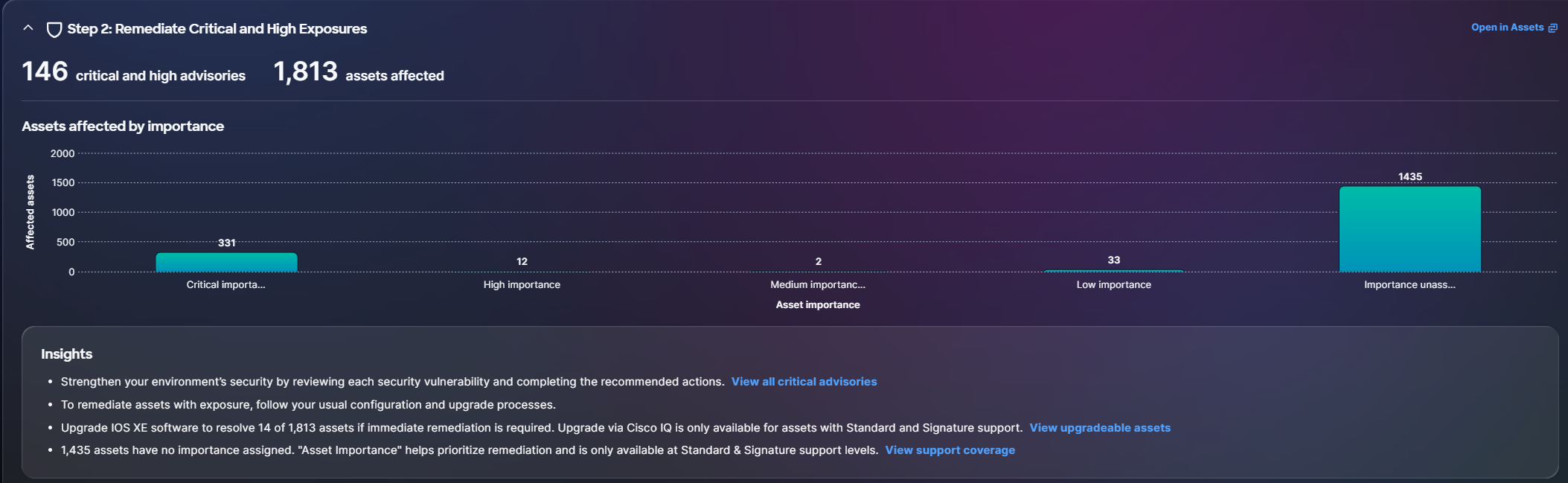
Line those risk categories up against your own environment and the picture gets uncomfortably clear, fast — which is rather the point.
What This Means for Your Team
None of this replaces the people running your network.
What it does change is where your team spends its time. Instead of manually cross-referencing a CVE advisory against your asset inventory, or trying to remember which sites are still running gear past its last day of support, Cisco IQ surfaces that correlation for you — so your engineers can focus on the decision, not the detective work.
If you're building a business case, the peer benchmarking data is worth paying attention to on its own. It's a rare, credible answer to the "are we behind?" question that usually gets answered with guesswork.
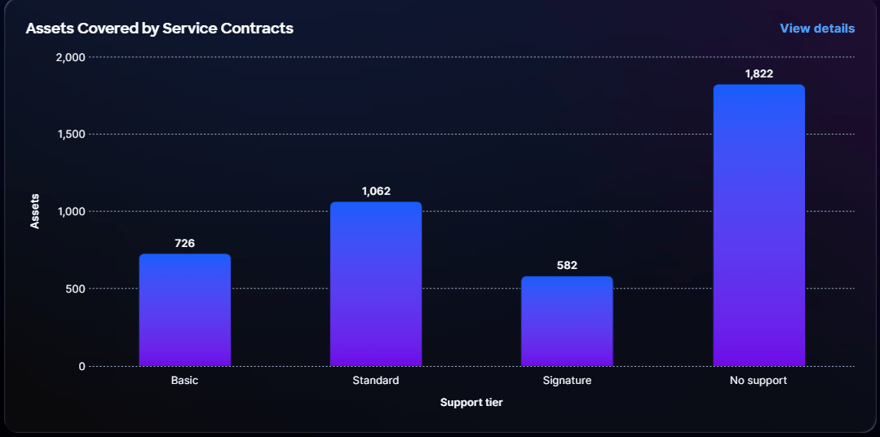
Access itself rides on your existing Cisco Support contract, tiered as Basic, Standard or Signature. Basic gets your team self-service troubleshooting through the AI Assistant; Standard adds deeper case management, RMA tracking and trend reporting; Signature unlocks the full assessment and benchmarking suite.
Cisco IQ: Summary
Cisco IQ is Cisco's bet that the next real advantage in infrastructure isn't another tool — it's an AI layer that actually understands the tools you already have, grounded in Cisco's own engineering knowledge, and constrained enough that CIOs can trust what it tells them to do. It's live now, integrated into Cisco Cloud Control, with Controlled Availability running in the US since June 2026 and wider regions following progressively through the rest of the year.
If end-of-life exposure or Zero Trust planning are already on your risk register, now's a good time to start working out where Cisco IQ fits in your environment.
Want a Hand Making Sense of It for Your Environment?
If you'd like a hand working out what Cisco IQ means for your environment — or just want someone to translate the vendor briefing into a plan — get in touch via our contact page, or email us at sales@iptel.com.au and we'll line up a time for a chat.