.png?width=200&height=59&name=IPTellogo-byline-2020-dark-v2-pnd-optimised-500%20(1).png "IPTellogo-byline-2020-dark-v2-pnd-optimised-500 (1)")
Storage used to be the box in the corner that the network team plugged in and hoped for the best. With FlashStack, it's part of the design from day one. In this blog, we'll explain what FlashStack is, where Everpure (formerly Pure Storage) fits, how it connects to your Cisco network, and the design choices that decide whether it performs as promised.

FlashStack: What Is It?
.gif?width=173&height=173&name=Backup%20Assure%20for%20Key%20Cisco%20Platforms%20(Instagram%20Post).gif) FlashStack is a converged infrastructure design from Cisco and Everpure, the company formerly known as Pure Storage. It combines Cisco UCS servers, Cisco Nexus switching and, where Fibre Channel is used, Cisco MDS switches with Everpure FlashArray or FlashBlade storage, documented and tested as Cisco Validated Designs.
FlashStack is a converged infrastructure design from Cisco and Everpure, the company formerly known as Pure Storage. It combines Cisco UCS servers, Cisco Nexus switching and, where Fibre Channel is used, Cisco MDS switches with Everpure FlashArray or FlashBlade storage, documented and tested as Cisco Validated Designs.
Those Cisco Validated Designs (CVDs) matter more than the logos. Each one is a full build guide, from cabling and firmware versions to switch configuration, tested end to end by both vendors. You're not the first person to put these parts together, and you're not the one discovering the incompatibilities.
The name change can cause some confusion. Pure Storage renamed itself Everpure in 2026, but the products kept their names: FlashArray, FlashBlade, Pure1 and Evergreen. If a quote, a CVD or a support article says Pure Storage, it's the same platform. You can read more on our Everpure storage page.
FlashStack designs exist for virtual server infrastructure, virtual desktops, databases, healthcare platforms and AI. The common thread is predictable performance from compute, network and storage that were designed to work together.
Network Design: Where Everpure Meets Your Cisco Network
In a FlashStack, the network is the storage path. Servers reach the Everpure array through the Cisco UCS fabric interconnects and then either Nexus switches (for iSCSI, NVMe/TCP or NFS) or MDS switches (for Fibre Channel and NVMe over Fibre Channel), so switch design decides storage performance.
A current Cisco Validated Design shows the shape. Cisco UCS X210c M7 compute nodes sit in an X9508 chassis, connected to a pair of UCS 6536 fabric interconnects. Those connect up to a pair of Nexus 93360YC-FX2 switches in a virtual port channel (vPC) and, for Fibre Channel, a pair of MDS 9132T switches. The array is an Everpure FlashArray//X with two controllers.
The diagram below shows how the layers connect.
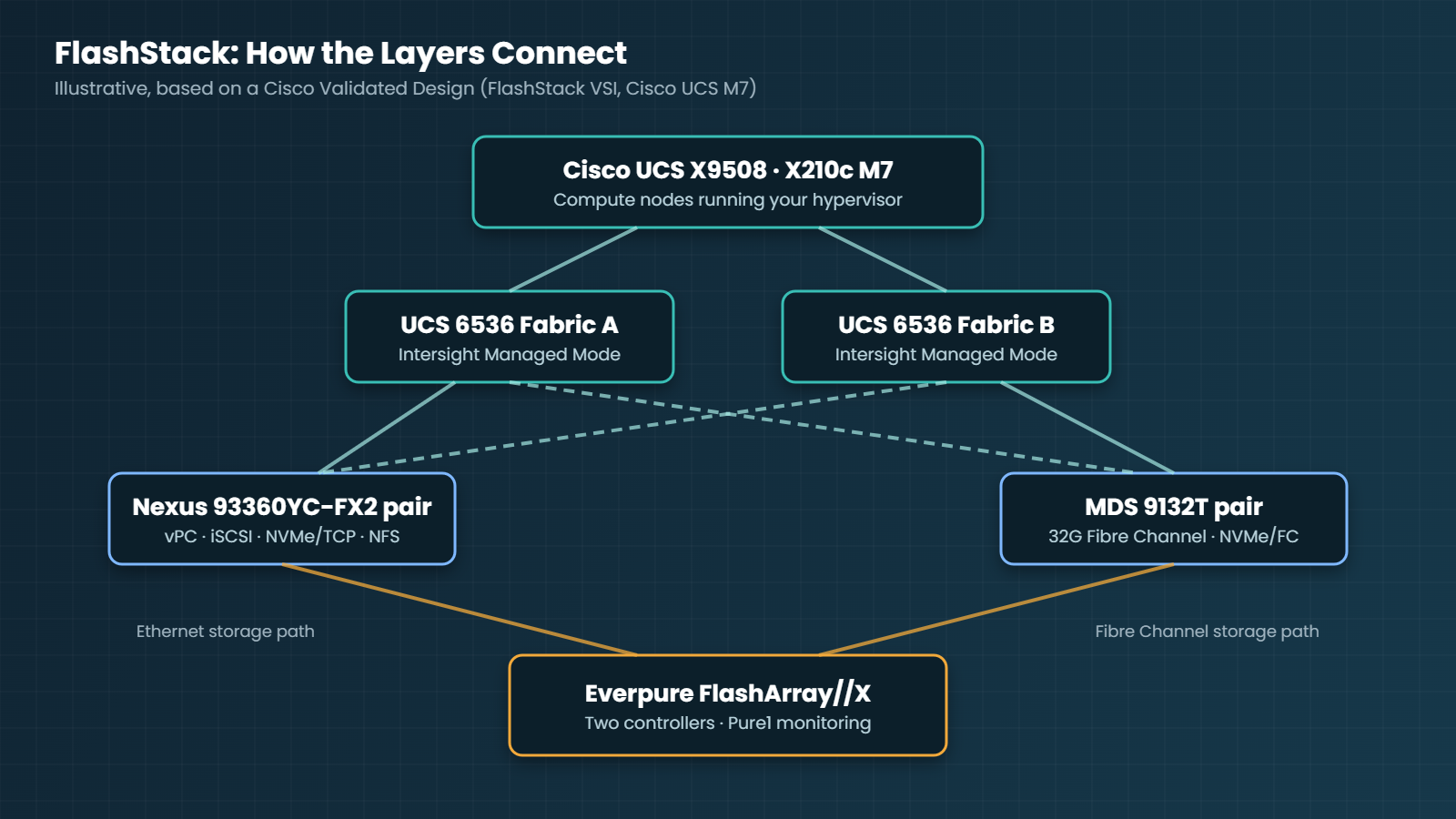
Every layer is built in pairs, with an A side and a B side. Lose a switch, a fabric interconnect or a controller and the storage path stays up. That's the point of the design, and it only holds if the cabling and configuration follow it exactly.
Pro-Tip: If you run iSCSI or NVMe/TCP, set jumbo frames (MTU 9000) consistently on the hosts, fabric interconnects, Nexus switches and array ports, then test with a do-not-fragment ping. One port left at 1500 is enough to cause intermittent latency that's very hard to trace.
Storage Protocols: Fibre Channel or Ethernet?
Choose Fibre Channel when you already run an MDS SAN and your team knows it well. Choose NVMe/TCP or iSCSI over Nexus when you'd rather run one Ethernet fabric. FlashStack validates both, and FlashArray also supports NVMe over Fibre Channel, NVMe/RoCE and NFS.
Fibre Channel gives you a separate, lossless storage network and a mature toolset. It also means a second set of switches, optics and skills to look after.
Ethernet storage runs on the Nexus switches you already manage, at 25 or 100 GbE. NVMe/TCP brings the efficiency of the NVMe protocol to standard Ethernet without special switch features, which is why it's become the default choice for many new builds.
There's no wrong answer here. The right one depends on what you already own, what your team is comfortable supporting at 2 am, and whether storage and data traffic share switches in your design.
Operations: How Do You Run FlashStack Day to Day?
.gif?width=173&height=173&name=Backup%20Assure%20-%20A%20Disaster%20Recovery%20Case%20Study%20(Instagram%20Post).gif) FlashStack is managed mainly from Cisco Intersight, Cisco's cloud management platform for UCS, with Intersight Assist bringing the Everpure array and Nexus switches into the same view. Everpure's own Pure1 adds array analytics and capacity forecasting, and Ansible playbooks automate the build.
FlashStack is managed mainly from Cisco Intersight, Cisco's cloud management platform for UCS, with Intersight Assist bringing the Everpure array and Nexus switches into the same view. Everpure's own Pure1 adds array analytics and capacity forecasting, and Ansible playbooks automate the build.
On the storage side, Evergreen subscriptions allow controller and capacity upgrades without moving data, so the dreaded forklift refresh goes away. SafeMode snapshots protect data from deletion, even if an administrator account is compromised.
Don't forget the network itself. The switch and fabric interconnect configurations are as critical as the data, and they need backing up too. We use Backup Assure for exactly that.
For customers who'd rather not run it themselves, our managed services team monitors the whole stack 24x7.
Use Cases: Where Does FlashStack Fit Best?
FlashStack fits best where storage performance and uptime directly affect the business: virtual server farms, virtual desktops, databases, healthcare records platforms and AI workloads. It also suits organisations rethinking VMware, because FlashStack now has validated designs for Nutanix as well.
Cisco publishes FlashStack designs for VMware vSphere server farms, for virtual desktops with Citrix and VMware Horizon, and for the Epic electronic health record platform. For AI, Cisco AI PODs pair UCS GPU servers and Nexus switching with Everpure FlashBlade.
For organisations reconsidering VMware, FlashStack with Nutanix runs the Nutanix AHV hypervisor on Cisco UCS with FlashArray connected over NVMe/TCP. Compute and storage scale independently, so you keep the external array instead of moving to hyperconverged storage. We cover the network side of that decision in VMware alternatives and your Cisco network.
FlashStack: FAQs
What Is FlashStack?
FlashStack is a converged infrastructure design that combines Cisco UCS compute, Cisco Nexus and MDS switching, and Everpure (formerly Pure Storage) FlashArray or FlashBlade storage. Each design is tested and documented as a Cisco Validated Design.
Is Everpure the Same as Pure Storage?
Yes. Pure Storage renamed itself Everpure in 2026. FlashArray, FlashBlade, Pure1 and Evergreen keep their names, and existing FlashStack designs and support arrangements still apply.
Does FlashStack Need Fibre Channel?
No. FlashStack supports Fibre Channel through Cisco MDS switches, but it also supports iSCSI, NVMe/TCP and NFS over Cisco Nexus Ethernet switches. Many new builds use NVMe/TCP over 25 or 100 GbE.
Can FlashStack Run Without VMware?
Yes. FlashStack with Nutanix runs the Nutanix AHV hypervisor on Cisco UCS with Everpure FlashArray storage, giving organisations a validated path away from VMware.
FlashStack: Summary
FlashStack takes the guesswork out of putting storage, compute and network together. Everpure provides the all-flash storage, Cisco provides the servers and switches, and the Cisco Validated Design ties them into one tested system. The network decisions, from protocol choice to redundancy and MTU, are what turn that design into consistent performance in your data centre.
Need Help With FlashStack and Everpure?
We design, supply and deploy Everpure storage with the Cisco compute and networking it runs on, and we can review your current environment with our Cloud & AI Assessment. If that's useful, get in touch with the IPTel team or email sales@iptel.com.au.