.png?width=200&height=59&name=IPTellogo-byline-2020-dark-v2-pnd-optimised-500%20(1).png "IPTellogo-byline-2020-dark-v2-pnd-optimised-500 (1)")
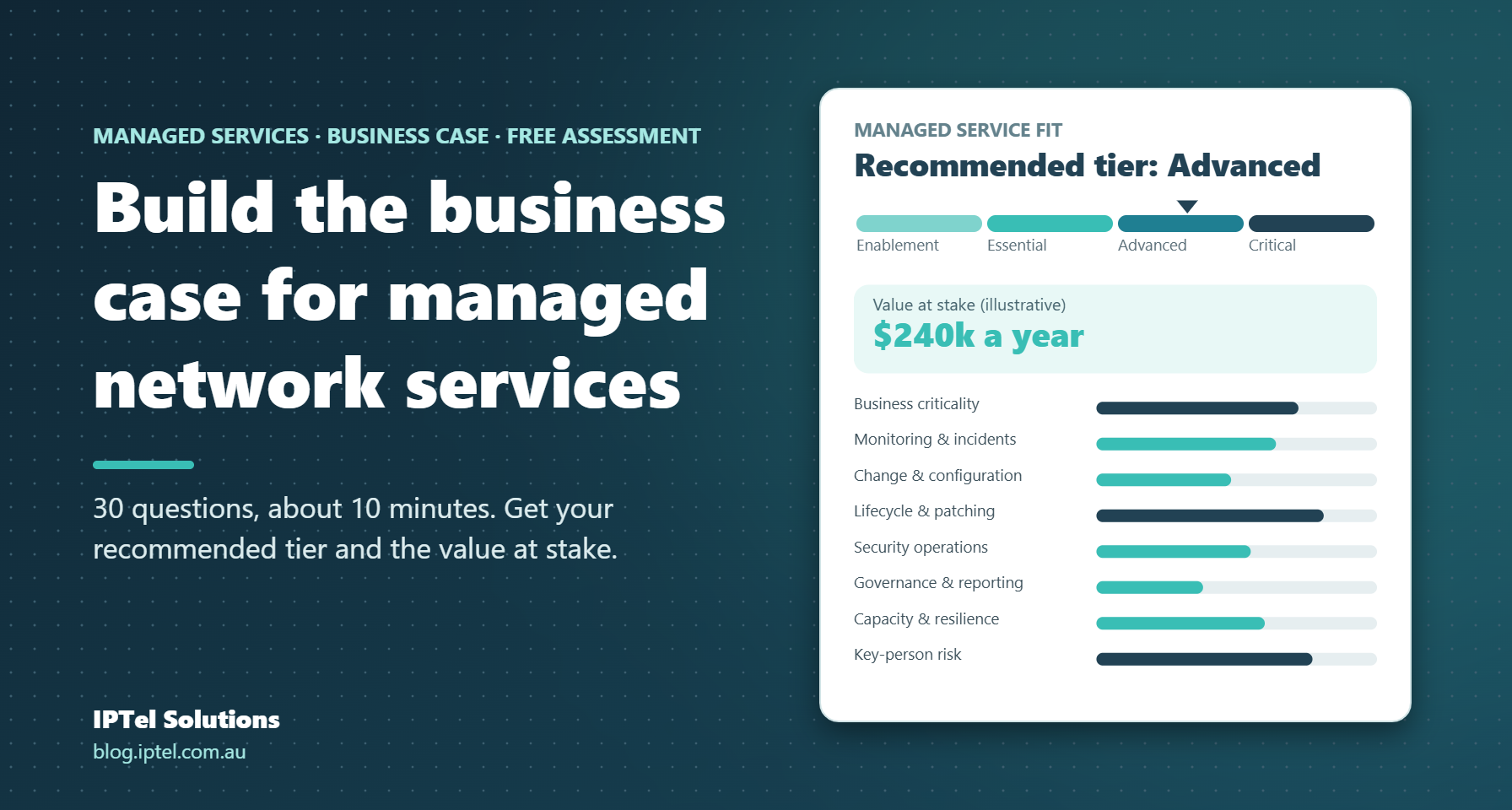
Most network teams know when they're stretched. Proving it to the people who sign off budgets is harder. In this blog, we'll walk through IPTel's new Managed Network Services Assessment: a free, 10-minute tool that turns your answers into a business case, with a recommended service tier and the value at stake for your network.
Business Case: Why Is Managed Services Hard to Justify?
.gif?width=173&height=173&name=Cisco%20Powered%20Managed%20Services%20(Instagram).gif) Managed services are hard to justify because the cost of running the network yourself is spread across salaries, after-hours call-outs and outages nobody has priced. The service fee is one clear number. The cost it replaces is scattered, so the comparison rarely gets made properly.
Managed services are hard to justify because the cost of running the network yourself is spread across salaries, after-hours call-outs and outages nobody has priced. The service fee is one clear number. The cost it replaces is scattered, so the comparison rarely gets made properly.
We see the same pattern again and again. A capable team of two or three engineers keeps the network running, but monitoring happens when someone has time, patching slips behind and one person holds most of the knowledge. Nothing is broken, so the case for change never quite makes it onto the agenda.
The point? Until those hidden costs are written down, a managed network service looks like a new expense rather than a better way to spend money you're already spending.
The Assessment: What Does It Cover?
The assessment asks 30 questions across eight areas of network operations: business criticality, monitoring and incident response, change and configuration, lifecycle and patching, network security operations, governance and reporting, capacity and resilience, and knowledge and key-person risk.
Each area is scored for how much pressure it puts on your current operating model. A higher score means a stronger case for handing that work to a managed service, and the report explains why for every area rather than just giving you a number.
You can complete it on your own, or sit down with your IPTel account manager and work through it together. Either way, it takes about 10 minutes, and the results appear on screen straight away. The full report follows by email.
Value at Stake: How Is the Number Built?
The value at stake is built from three of your own answers: engineer time spent on routine work, the yearly cost of network disruption, and what you spend on after-hours and external support. Added together, they give an annual figure for the cost of the current operating model.
Engineer time is calculated at an assumed loaded cost of $100 an hour over 46 working weeks. Disruption and external spend use the ranges you pick, so the figure reflects your environment rather than an industry average. If you don't know an answer, that line shows as zero and we work through it with you later.
What the figure isn't: IPTel pricing. It's the size of the problem a managed service addresses. The report shows how to read the return once a proposal is on the table (the value you recover, less the service fee, divided by the service fee).
Pro-Tip: Before you start, ask your team roughly how many hours a week go on monitoring, routine requests and first-line fault-finding. A rough weekly figure from the people doing the work makes the business case far more credible than a guess.
Service Tier: Which Level of Cover Fits?
.gif?width=173&height=173&name=Meraki%20Managed%20Service%20(Instagram).gif) Your overall score maps to one of IPTel's four managed service tiers. The tier is set mainly by how many hours your network has to run and what an outage costs, then adjusted for the pressure in the other seven areas.
Your overall score maps to one of IPTel's four managed service tiers. The tier is set mainly by how many hours your network has to run and what an outage costs, then adjusted for the pressure in the other seven areas.
Enablement suits teams that run their own network well and want expert help on hand. A Consulting Architect and a Senior Engineer work with you each month on technology adoption, lifecycle and design, without taking over day-to-day operations.
Essential covers business hours (8am to 5pm AEST) with a one-hour response to priority 1 incidents. Advanced extends cover from 6am to 6pm with a 30-minute response, adds quarterly patching and a shared customer success manager, and can include Cisco ThousandEyes.
Critical is for networks that can't go down. It runs 24x7x365 with a 15-minute response to priority 1 incidents, a named senior engineer and customer success manager, problem management and risk-based patching.
The report sets out what's included at your recommended tier and what would change if you stepped up or down a level.
Day to Day: How Would the Service Work?
The service is co-managed. You keep full administrative access to your environment for the whole term, and IPTel works alongside your team rather than instead of it.
We monitor your network with Highlight, our service observability platform, and you see the same live dashboards as our Network Operations Centre: device health, performance and open incidents, organised by site and service. Incidents, changes and requests run through the IPTel Customer Portal, built on Jira Service Management, so planned changes, reports and root cause analyses all sit in one place.
Every engagement starts with a structured transition, which typically takes four to twelve weeks. In the first 90 days we audit the environment, set up monitoring and alerting, build a risk register and agree a remediation plan. You finish that period with a documented network, whichever tier you choose.
Managed Services Business Case: FAQs
How Do I Build a Business Case for Managed Network Services?
Start by putting a number on what the current model costs: engineer time on routine work, the cost of disruption and after-hours support spend. IPTel's free assessment does this from your own answers and recommends the service tier that fits.
How Long Does the Assessment Take?
About 10 minutes. There are 30 questions, the results show on screen when you finish, and the full business case report is emailed to you.
Does the Report Include Pricing?
No. The value at stake is the cost of your current operating model, not an IPTel price. Pricing follows a scoping session, once we've confirmed sites, platforms and service hours.
Can My Account Manager Complete It With Me?
Yes. Many customers work through it with their IPTel account manager, who can help with the estimates and explain the recommended tier.
Managed Services Business Case: Summary
The hardest part of moving to a managed service is usually proving the case, not choosing a provider. The Managed Network Services Assessment puts a figure on the cost of the current model, shows where your operating model is under pressure and matches you to a service tier, all in about 10 minutes and in a report you can take straight to your leadership team.
Need Help With Your Managed Services Business Case?
Start the free Managed Network Services Assessment, read more about our managed services, or get in touch with the IPTel team at sales@iptel.com.au to book a scoping session.